.png)
Reactive Dog Training Calgary | Can You Train a Dog to Stop Being Reactive?
Updated: Dec 30, 2025
Reactivity is one of the most common reasons people reach out for reactive dog training in Calgary; barking, lunging, freezing, growling, spinning, avoiding, or having an outsized emotional response to everyday triggers.
So let’s tackle the big question:
Can you train a dog to stop being reactive?
Yes , BUT the real answer is deeper than that. Reactivity doesn’t improve with “quick fixes,” food scattering, or avoiding the neighbor’s dog forever. It improves when we understand the dog’s drive state, meet their actual needs, and build a communication system that creates clarity.
What Causes Dog Reactivity? (Hint: It’s Not Usually Trauma)
Most families seeking reactive dog training Calgary are surprised to learn that reactivity usually isn’t caused by a single traumatic event. In many cases, reactivity doesn’t appear out of nowhere. It often emerges when a dog enters adolescence and the expectations placed on them no longer match their emotional and biological capacity. Learning to recognize which stage of development your dog is in can explain sudden behavior changes and guide more effective training decisions. Reactivity is usually a pattern the dog has unintentionally rehearsed over time. The two biggest root causes of reactivity are:
1. Lack of Clarity in Communication
Without knowing what their boundaries are on certain behaviors, dogs default to instinct, often defense drive (fight/flight/freeze).In this drive, dogs feel unsafe and act accordingly.
2. Unmet Physical & Genetic Needs
Many dogs in suburban Calgary are under-fulfilled. They need physical movement, mental engagement, and drive fulfillment, not just licki mats and 20-minute walks around the block.
When these needs are unmet, stress rises and reactivity increases.
Understanding Drive States: The Foundation of Reactive Dog Training
At Canine Development and Testing, I teach owners to understand their dog’s drive state, because a reactive dog is almost always stuck in the wrong one.
Pack Drive → calm, coachable, responsive, connected
Prey Drive → chasing, scanning, hunting, overstimulated
Defense Drive → barking, lunging, avoidance, fear, anxiety, fight/flight/freeze
Reactive dogs are almost always in prey or defense drive (or both). Our job isn’t to punish or suppress it, it’s to coach them back into pack drive, where they can think clearly and respond to direction.
Once you understand this, everything starts to make sense.
Where Dog Owners Get Stuck With Reactivity
After working with countless reactive dogs, these are the most common patterns I see:
1. Over-reliance on food
Treats alone won’t change reactivity. Food without communication is distraction, not training.
2. Insisting on stressful neighborhood walks
If your dog reacts to everything on the street, daily city walks are adding fuel to the fire. Every reaction rehearses the behavior you’re trying to eliminate.
3. Avoiding triggers forever
Avoidance is part of the early plan, but it cannot be the whole plan. Once the dog has clarity, we must address real-life triggers.
4. Ignoring drive fulfillment
Most reactive dogs need:
Trotting next to a bike
Tug
Flirt pole
Purposeful search games
Movement in nature (this alone changes everything)
This is one reason I created Parks for Pets, our private off-leash dog park east of Calgary. Dogs need space to move, decompress, and be dogs.
The PAWS Framework: Our Proven System for Changing Reactive Behavior
No matter the dog or the cause, we follow our PAWS Framework (Proactive Approach to Wellness & Skills). It’s holistic, repeatable, and has helped some of Calgary’s most reactive dogs transform into calm, coachable companions.
1. Health
Sleep, stress load, nutrition, pain, allergies etc. all contribute to reactive behavior.
2. Communication
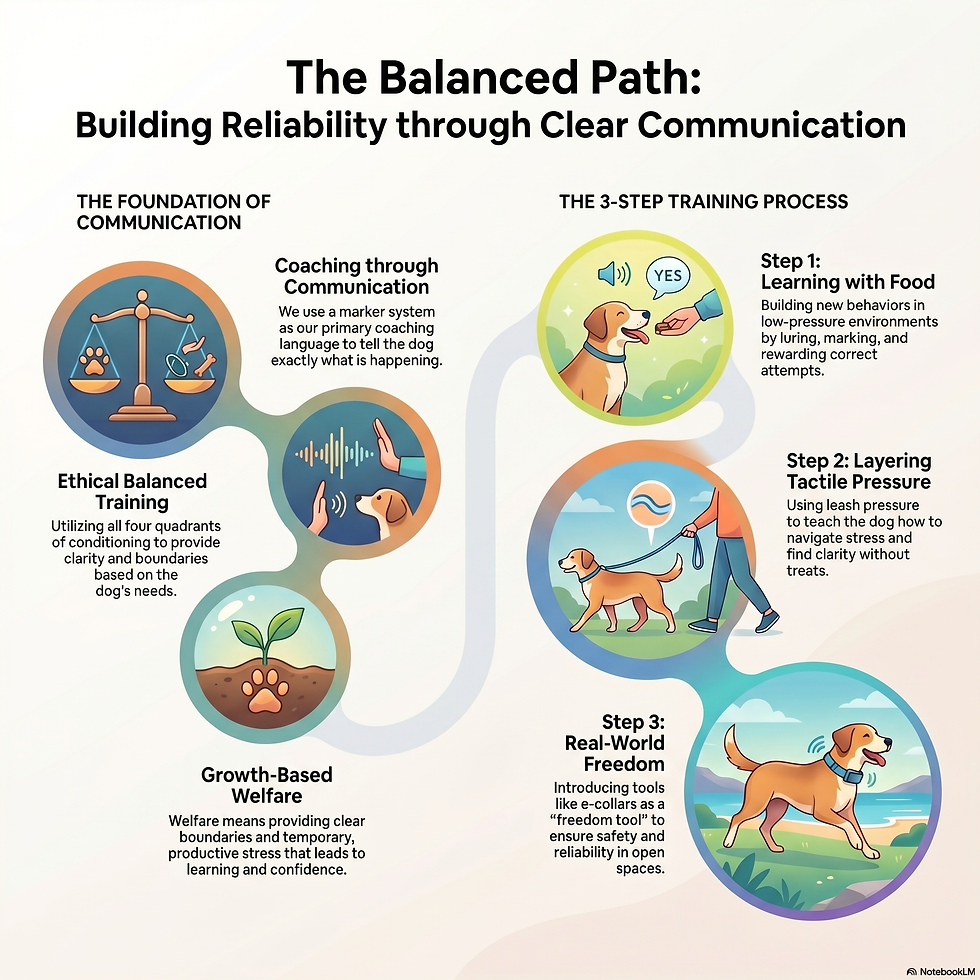
Leash pressure, markers, cues, and appropriate tools (including e-collars when they support clarity and off-leash freedom).
3. Exercise
Structured physical movement, not endless fetch.
4. Enrichment
Purposeful, drive fulfillment.
5. Management
Preventing rehearsal of reactive behaviors in the environment.
6. Structure
Predictability and routine reduces stress.
7. Training & Skills
Only once the dog has clarity, fulfillment, and regulation do we introduce controlled exposure to triggers and train specific skills.
How I Train a Reactive Dog (My Actual Board and Train Process)
Week 1: Stabilization & Reset
Full wellness review
Decompression
Drive fulfillment
Lots of rest
Removal of high-stress environments
Introduce the communication system
Week 2–3: Clarity, Skills & Patterning
We build coachability, connection, and the dog’s ability to move back into pack drive in various environments starting with no triggers and working up to triggers in close proximity. We do a lot of patterning in this phase.
Week 4–6: Exposure and Generalization
Once the dog understands our expectations, we expose them to new environments to generalize their skills and understanding. . This is where the transformation happens, safely and intentionally. It's also what supports the dog's success at home. They aren't trained only in our training facility.
Reactive Dog Case Studies
These case studies show what’s possible through our reactive dog training Calgary programs.
Penelope

Penelope’s reactivity was triggered by downtown apartment living, daycare overstimulation, under sleeping, and constant environmental stress. With decompression, clarity, and fulfillment, she became calm, coachable, and capable of navigating elevators, hallways, and city walks without lunging or barking.
Her owners say: "We sent our dog to CDT for a board and train program and the results are outstanding! We needed help with our dogs reactivity. Before we took her to CDT we were struggling with negative interactions from other dogs, people, kids, bikes, scooters, you name it! She was also very barky in the house. Now, we can go on walks with her and she walks good on her leash, not pulling, not reacting to people/animals we pass and we don't have to deal with demand barking inside our home. We can have guests over and she remains calm and not aggressive. CDT taught both us and her skills to work through situations and how to communicate with our dog clearly."
Penelope’s transformation wasn’t accidental, it was the result of meeting her needs, giving her clarity, and coaching her through the real-life scenarios that used to overwhelm her.
Wilfred

Wilfred arrived incredibly defensive, anxious, and untrusting. Once we fulfilled his needs, created structure, and taught him how to shift out of defense drive, he became the confident companion his owners always wanted.
His owners say: "Our Lab joined Tamara for a 6 week board and train session to work on some anxiety and reactivity. He came home a different dog - literally. Well, the same, loveable companion but without the anxiety and bad behaviours that were very risky and no fun (put gently).
It's worth noting that prior to CDT, we did do two sessions of training with a very reputable company in Calgary but they didn't help us at all with the mindsets and drives needed to succeed which was the main thing we needed as it turns out!
We cannot say enough about our positive experience with Tamara and her team. She was able to get to the core issues quickly, build new behaviours and teach us how to (easily) keep it going. We are so grateful. Because of this, we are able to enjoy life with our dog like we always dreamed we could!
Her communication and resources are incredible and it's clear she is a very talented trainer. I highly recommend her to anyone looking for general training - or to help rehab a dog."
Wilfred’s shift was one of the most rewarding transformations of the year for my team, he finally felt safe, understood, and supported.
Shadow

Shadow had both predatory interest in dogs and insecurity, making him one of the harder cases. Through structured exercise (including biking), clarity, and coaching, he became thoughtful, responsive, and capable of making better choices. Months later, he’s continuing to improve at home.
Shadow's owner shares: "Tamara and her team worked pure MAGIC! I brought Shadow, a 2 year old Border collie/Lab rescue to them. He was very reactive of other dogs, pulled on the leash and was just a menace outside haha, I tried other training courses with no avail. After talking with several friends who have brought dogs to Tamara I decided to do the 6-week board and train. Shadow is now coachable, and can think through situations with other dogs near by. He walks loose leash, has recall and is e-collar trained, giving us the confidence to go on more adventures and to go find other dogs to practice the skills we learnt during training. We still have some work to do with Shadow, but the progress that has been made is incredible! Highly recommend Canine Development and Testing. Will definitely be doing more training with them in the future! Thank you again to the whole team!"
Shadow isn’t “perfect”, and he doesn’t need to be. He’s calm, coachable, and capable of handling the world in a way that was impossible before.
And, if you want to know how much these programs cost? Check it out.
So… Can You Train a Dog to Stop Being Reactive?
Yes. But not with simple tips, treat scattering, or hoping the issue disappears.
You change reactivity by changing the dog’s state, not the symptom.
Reactive dogs need:
Clarity
Structure
Correct exercise
Decompression
Coaching through triggers
A communication system
A predictable environment
Drive fulfillment
Reactivity is not a personality trait. It’s a pattern, and patterns can be changed.
If Your Dog Is Reactive in Calgary, Book a Call
If you’re struggling with leash reactivity, fear-based reactivity, dog-dog issues, or unpredictable behavior, you do not need to continue guessing your way through this.
Our Board & Train for reactive dogs is designed to do the heavy lifting for you, providing clarity, structure, and a system you can easily maintain at home.
If your dog is reactive in Calgary or even if you're out of town (we have plenty of people travel to drop-off) and you’re ready to make a plan, book a call. Let’s bring clarity, confidence, and calm back into your life.

Comments