
Kindness Isn't Found in The Absence of Pressure.
KINDNESS ISN’T FOUND IN THE ABSENCE OF PRESSURE. IT’S FOUND IN THE PRESENCE OF CLARITY.
You love your dog. You’ve read the books, watched the videos, and tried to do everything “right.” Yet sometimes, you still feel like you’re failing. You’ve walked away from a conversation with a trainer, veterinarian, or online “dog welfare advocate” feeling small, like you’re a bad person for being at your wits end. You’ve hesitated to use a tool or apply a consequence because someone told you that’s cruel. You love your dog deeply, yet you still feel trapped by their behaviour and afraid to say that out loud.
This is for you. For the dog owners who are being guilted into ideology instead of being supported into clarity.
There’s a growing narrative in the dog world that true kindness means avoiding any form of pressure, consequence, punishment, or structured communication. It’s been packaged and sold under terms like fear-free, force-free, and positive-only. Of course we do not want to harm dogs. Of course welfare matters. But somewhere along the way, we began treating any moment of discomfort in training as abuse, while ignoring the quiet suffering that comes from a life of management, restriction, and unpredictability.

I’ve met far too many owners living in silent misery. Canceling vacations because their dog can’t be confined. Apologizing to guests they can’t have over. Crying at home after another walk went sideways. We’ve convinced them that using a consequence is cruel, yet we accept a life where the dog cannot go anywhere, do anything, or experience freedom. A dog who cannot handle the world is not being protected by “kindness.” It’s being trapped by it.
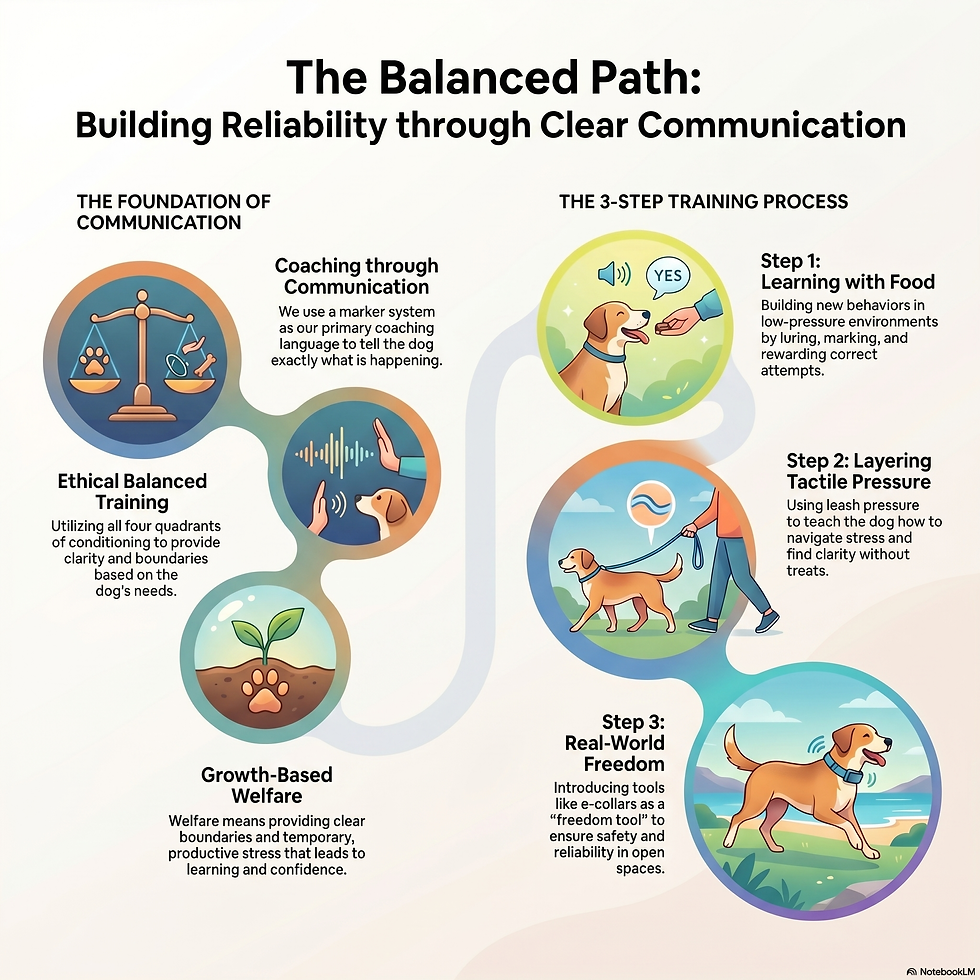
We forget that the brain learns through two forces: it seeks pleasure, and it avoids discomfort. That’s not harsh; that’s biology. To deny it is to deny how all living things learn. Food is powerful, and yes, we use it. Praise is powerful, and yes, we use that too. But there must also be a clear way for a dog to understand how to turn off pressure, how to avoid making the same error again, and how to develop resilience through fair challenges.
Many owners have been taught to fear tools. They hear words like prong collar or e-collar and imagine pain. They haven’t seen what happens when a tool is layered into communication with skill and fairness. They haven’t seen how it can unlock understanding and create more freedom, not less. You can love your dog, meet their emotional needs, advocate for their welfare, and still hold boundaries with clarity. You don’t have to choose.
When we avoid pressure, consequences and punishment entirely, we don’t create kinder relationships. We create anxious ones. Dogs without boundaries don’t relax. They escalate. They spin, they scream, they fixate, they snap, and they never learn how to self-regulate. They live in constant emotional volatility because no one has shown them where the off-switch is. A calm body is not a calm mind. Enrichment toys cannot replace communication. Lick mats cannot teach a dog how to handle stress. Avoiding conflict does not create peace.
You do not have to choose between loving your dog and leading your dog. Structure is not dominance. Correction is not cruelty. Pressure is not abuse when it is followed by release and understanding. You can still let your dog on the couch, still cuddle them at night, and still expect them to respond to you with clarity and respect. This is not an all-or-nothing equation.
What frustrates me most isn’t that different methods exist. It’s that we’ve turned them into a moral identity. Some trainers and veterinary professionals have shamed owners out of seeking solutions because they themselves do not understand the full spectrum of behaviour and learning science. Instead of saying, “I don’t use those tools, but I respect those who use them well,” they warn, frighten, and judge. Owners leave feeling smaller instead of stronger. That is not advocacy. And you should never leave a conversation with a professional feeling confused or conflicted. That is not kindness.
Kindness is not the absence of pressure. Kindness is the presence of clarity. It’s our responsibility to teach dogs how to navigate both reward and consequence in a way that builds trust, agency, and resiliency. Dogs will experience stress in life regardless. Our job is not to protect them from every moment of it. Our job is to teach them how to move through it with confidence.
If you are an owner who has felt ashamed, scared, or unsure because the messaging around training made you question your own goodness, hear this clearly: you are not a bad person for wanting a functional life with your dog. You are allowed to seek leadership without guilt. You are allowed to ask for more than survival. You are allowed to want peace, both in your home and in your mind.
And if your trainer or veterinarian left you feeling judged instead of supported, that was not kindness. Do not let someone else’s ideology rob you of the chance to have a thriving, fulfilled partnership with your dog.
You are not alone for wanting clarity.
You are not cruel for wanting structure.
You are not wrong for believing that love and boundaries can coexist.
They always have.
If you’re ready to learn a communication system that honours both your dog’s welfare and your life as a human being, I’m here for that conversation.
Clarity is kindness.
Tamara

Comments