.png)
Dog Training Without the Kool-Aid: Our Philosophy, Methods, and Ethics
There are a lot of training philosophies out there. Most of them come with a camp, a set of rules about what you’re allowed to use, and an implied judgment of anyone who does it differently.
We’re not interested in any of that.
Our approach is process-driven and adaptable. It’s grounded in a wide-lens view of behavior, wellness, and practical outcomes. We use what works, we don’t use what doesn’t, and we make those decisions based on the individual dog in front of us — not on ideology.
If you want a label: technically, we are balanced trainers. But if that word makes you nervous, keep reading. What it means in practice is probably not what you’re imagining.
What “Balanced” Actually Means
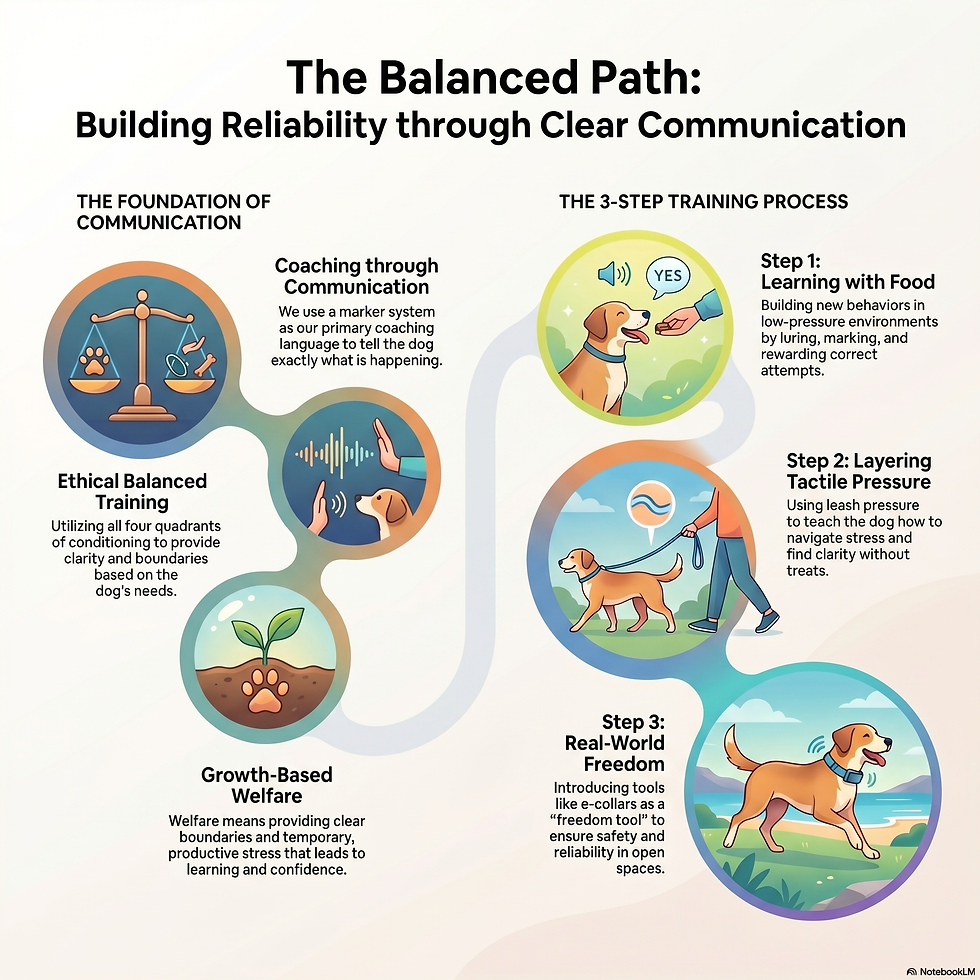
Balanced training means using all four quadrants of operant conditioning — positive reinforcement, negative reinforcement, positive punishment, and negative punishment — ethically and in the right context.
What it doesn’t mean is reaching for a correction first, suppressing behavior without understanding it, or treating aversive tools as shortcuts.
The trainers who give balanced training a bad reputation are usually doing one of two things: applying punishment before the dog has been taught what to do instead, or using tools without the skill to use them well.
On the other side, the trainers who give positive-only training a bad reputation are usually doing something equally unhelpful: keeping dogs in a comfortable bubble, managing around problems instead of addressing them, and calling it welfare.
Both cause harm. Just different kinds.
How We Actually Communicate With Dogs
Most dog training conversations spend too much time on quadrants and not enough time on communication.
The quadrants are a framework for understanding how behavior is influenced. They’re useful for trainers to know. They’re not particularly useful for owners to memorize, and they’re not what we’re thinking about when we’re actually working a dog.
What we’re thinking about is our marker system.
Markers are our coaching language. They tell the dog precisely what’s happening in real time:
∙ You were correct, reinforcement is coming, and here’s where to expect it
∙ Whether the behavior is over, or in progress (duration)
∙ That was incorrect, and there will be a consequence
That last marker is the one most training systems leave out. And its absence is often where the confusion starts.
How we build behavior
We teach almost everything through food first. Lure, mark, reward correct attempts. The dog learns what we’re asking for in a low-pressure, high-clarity environment.
From there we layer in leash pressure — negative reinforcement — teaching the dog how to turn off leash pressure by responding correctly to known behaviors. This isn’t about discomfort for its own sake. It’s about teaching the dog a skill: how to navigate pressure, how to release it, and how to work through mild stress toward a clear outcome.
Once leash pressure is understood, we may layer in an e-collar if the dog and goals call for it. Both the leash and the e-collar, once properly introduced, can function as negative reinforcement or positive punishment depending on how they’re applied. We also use negative punishment — withholding reward for incorrect responses — throughout the process.
In practice this is intuitive, not calculated. We’re not stopping mid-session to identify which quadrant we’re in. We’re reading the dog and responding based on many years of experience and observation.
From Reward to Reliability
Food is a teaching tool. It’s not meant to be a permanent part of the picture.
If a dog only performs when food is visible, the job isn’t finished. A solid skill means one cue: a word or a gesture, is what the dog is responding to. Not the smell of chicken. Not the treat pouch on your hip. The cue.
Getting there requires fading the food out systematically and building stimulus control. That process involves some frustration for the dog. That frustation is simply how learning works and shouldn't be something we avoid.
A lot of dogs come to us having been through programs where that step never happened. They’re frantic, food-fixated, and fall apart the moment there’s nothing in the owner’s hand. The foundation is often there. What’s missing is the follow-through — the part where the dog learns to work without a guaranteed payout on every repetition.
That middle piece — the leash pressure layer — is usually what closes that gap. It gives the dog a different kind of clarity that food alone doesn’t provide and it allows us to provide tactile feedback to the dog, without reaching for more cookies, when they're confused or make a mistake.
How We Think About Tools
Which tools we use, if any, comes down to what the dog shows us.
A mild, coachable dog working with a capable owner may need nothing beyond a slip lead. A large, high-drive dog with a long history of pulling, owned by someone smaller, is a reasonable candidate for a prong collar, because it’s genuinely safer for the dog, the owner, and anyone else nearby.
Before any tool gets introduced, the dog already understands the behavior on a verbal cue along with leash pressure. They also know how to turn pressure off.
Introducing a tool to a dog with that foundation is a low-stress process. Doing it before that foundation exists is where things go sideways.
On e-collars specifically
We think about the e-collar as a freedom tool, not a last resort.
Dogs should have access to as much of the world as possible — off-leash time, open spaces, nature. The e-collar is what makes that realistic. It defines clear boundaries so we can safely expand them.
If an owner tells us their dog chases wildlife, is difficult to manage at home, or the goal is off-leash reliability, an e-collar is almost always part of the conversation. Not to correct the dog into compliance, but to give the dog a bigger life.
What Welfare Actually Means in a Training Program
Welfare in training does not mean the absence of stress.
When I took statistics in university, I cried. It was genuinely hard. But I came out the other side better off than if I’d avoided it entirely. Dogs are no different.
Stress is part of learning. The question isn’t whether a dog experiences any stress — it’s whether the stress is appropriate, temporary, and producing growth rather than shutdown.
Day to day, here’s what we’re watching for:
∙ Is the dog happy to come out and work?
∙ Are appetite and body functions normal?
∙ Can the dog settle with coaching?
∙ Is the session progressing in a way we’d be comfortable showing?
That last one is a practical standard we actually use. We feel comfortable posting our training sessions on the internet for all to see. And in fact, we send our owners many of the daily training sessions we do behind closed doors so our training methods, decisions and actions aren't a black box to them.
A dog that’s perfectly comfortable every moment of every training session probably isn’t being pushed enough to make real progress. Rest should feel comfortable. Training should feel like a challenge.
Where we see welfare failures — on both sides
Trainers cause real psychological harm by leaving dogs without clear boundaries and direction. A dog that doesn’t understand what’s expected of it isn’t a free spirit. It’s a stressed one. Trying to shape your way around every uncomfortable behavior, because addressing it directly feels harsh, often creates more anxiety than it prevents.
We also see harm from the other direction: trainers trying to resolve deeply ingrained behavior in a single session through significant pressure. Leash reactivity didn’t develop in a day. It doesn’t get resolved in one session without suppressing the underlying emotional state. That suppression tends to surface later, often in worse ways.
Both of these are welfare failures. Neither camp has a monopoly on causing harm.
What We Need From Owners
We ask a lot of our training dogs. We also ask a lot of our owners.
That means coming in genuinely open, not attached to what didn’t work with the last three trainers. It means prioritizing drive fulfillment and real decompression after training, which is the piece most people skip because it’s also the hardest. And it means being honest with us about where things are falling apart at home, because we can only work with what we know. We’ll tell you what you need to hear. We expect the same back.
What We Want You to Know
There’s one thing most dog owners don’t realize about the CDT team when they hire us. We are probably more worried about your dog’s wellbeing and training outcomes than you are.
We lose sleep over your dogs. We replay sessions. We second-guess decisions. We pour everything we have into the animals in our care because the work matters to us in a way that goes well beyond the professional. When you hand us your dog, you’re not handing them to a service. You’re handing them to people who genuinely care about their day-to-day welfare, health and mental well-being.
A Final Note on Methods and Labels
The dog training world loves a debate. Positive-only versus balanced. Science-based versus traditional. Tools versus no tools.
What actually matters is whether the trainer in front of you can clearly explain what they’re doing and why, whether they’re reading the dog or following a script, whether welfare and outcomes are both part of the conversation, and whether they’re honest when something isn’t working.
The label matters less than what the trainer can actually explain, justify, and back up with results. That’s the standard we hold ourselves to. It’s a reasonable one to apply to anyone else too.

Comments